
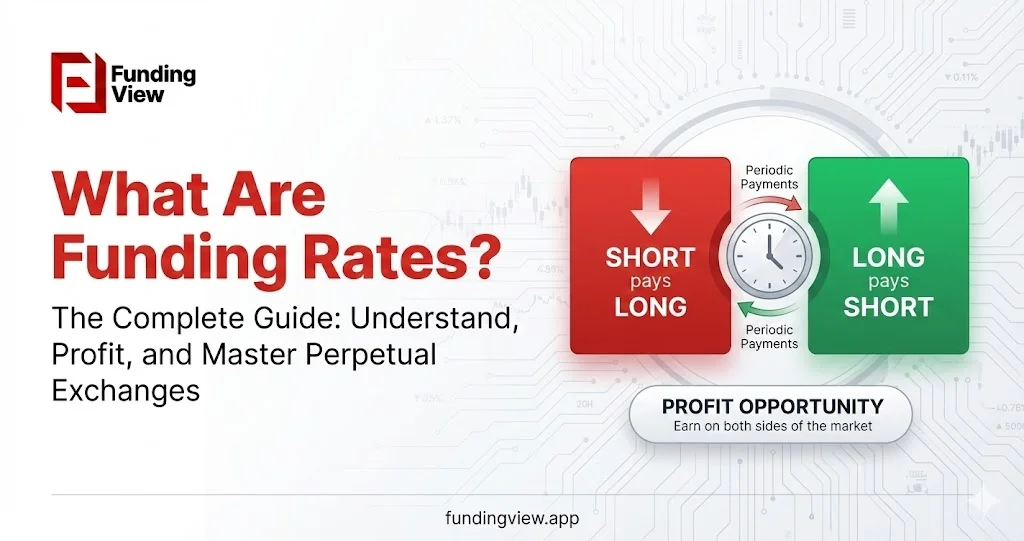
What Are Funding Rates? The Complete Guide for Perpetual Trading
Understand how funding rates work on perpetual exchanges, why they exist, and how traders use them to profit from the spread between exchanges. Essential knowledge for FundingView users.
If you've ever traded perpetual contracts, you've probably noticed a "funding rate" number next to your position. But what does it actually mean, and why does it matter?
In this guide, we'll break down everything you need to know about funding rates and how tools like FundingView (Funding View) help you profit from them.
Track funding rates in real-time with FundingView →
What Are Funding Rates?
Funding rates are a mechanism that keeps perpetual contract prices aligned with the underlying spot price.
Unlike traditional futures that expire on a specific date, perpetual contracts never expire. This creates a problem: without an expiration date forcing convergence, the perpetual price could drift away from the spot price indefinitely.
Funding rates solve this by creating periodic payments between long and short traders.
This is the core concept every Funding View user needs to understand to profit from funding rate arbitrage.
How Do Funding Rates Work?
The funding rate determines who pays whom:
- Positive funding rate → Longs pay shorts
- Negative funding rate → Shorts pay longs
This payment happens at regular intervals (every 1 hour or 8 hours, depending on the exchange).
FundingView displays all these rates in real-time across 10+ perpetual DEXs, making it easy to compare.
The Logic Behind Funding Rates
When the perpetual price trades above the spot price:
- The funding rate becomes positive
- Long positions pay short positions
- This incentivizes traders to short, pushing the price down
When the perpetual price trades below the spot price:
- The funding rate becomes negative
- Short positions pay long positions
- This incentivizes traders to long, pushing the price up
This self-correcting mechanism keeps the perpetual price anchored to spot. Funding View helps you track these movements across all major exchanges.
The Funding Rate Formula
The funding rate consists of two components:
1. Interest Rate Component
A fixed rate representing the cost difference between borrowing USD versus holding crypto. On most exchanges, this is set at 0.01% every 8 hours (approximately 11.6% APR), paid to shorts.
2. Premium Component
This fluctuates based on the price difference between the perpetual contract and the spot oracle price:
Premium = (Impact Price - Oracle Price) / Oracle Price
The final funding rate combines both:
Funding Rate = Premium + clamp(Interest Rate - Premium, -0.05%, 0.05%)
FundingView calculates all of this for you and displays the final annualized APR.
A Practical Funding Rate Example
Let's walk through a real calculation:
Given:
- Spot (Oracle) Price: $10,000
- Perpetual Impact Bid Price: $10,100
- Interest Rate: 0.01% (fixed)
- Your Position: 10 BTC long
Step 1: Calculate the Premium
Premium = ($10,100 - $10,000) / $10,000 = 1%
Step 2: Calculate the Clamped Difference
Clamped = clamp(0.01% - 1%, -0.05%, 0.05%) = -0.05%
Step 3: Calculate the Funding Rate
Funding Rate = 1% + (-0.05%) = 0.95%
Step 4: Calculate Your Payment
Payment = 10 BTC × $10,000 × 0.95% = $950
As a long holder with positive funding, you would pay $950 to short holders at this funding interval.
This is why Funding View users look for opportunities to be on the receiving side of funding!
Funding Rate Intervals by Exchange
Different exchanges use different funding intervals. FundingView normalizes all rates to hourly for easy comparison:
| Exchange | Funding Interval | Track on FundingView |
|---|---|---|
| Hyperliquid | Every 1 hour | View Rates |
| Paradex | Every 1 hour | View Rates |
| Extended | Every 1 hour | View Rates |
| Lighter | Every 1 hour | View Rates |
| Vest | Every 8 hours | View Rates |
| Backpack | Every 8 hours | View Rates |
Important: If an exchange shows an 8-hour rate but pays hourly, they divide the rate by 8 for each payment. Funding View handles these conversions automatically.
Key Things to Know About Funding Rates
1. Funding is Peer-to-Peer
The exchange doesn't take any fees from funding payments. It's purely a transfer between traders. This makes funding rate arbitrage a zero-sum game between longs and shorts.
2. Oracle Prices Matter
The spot price used in calculations comes from weighted median prices across major exchanges, not from a single source. FundingView tracks these oracle prices for accuracy.
3. Funding Caps Exist
Most exchanges cap funding rates to prevent extreme payments. Hyperliquid caps at 4% per hour, which is less aggressive than many CEXs.
4. Payment Calculation
Funding Payment = Position Size × Oracle Price × Funding Rate
Note that the oracle price (not mark price) is used to calculate the notional value.
Why Funding Rates Matter for Traders
For Position Traders
High funding rates can significantly eat into your profits if you're on the paying side. A 0.1% hourly rate compounds to 87.6% annually!
Always check FundingView before opening a position to understand the funding cost.
For Arbitrage Traders
Different exchanges have different funding rates for the same asset. By going long on one exchange and short on another, you can capture the spread while remaining market-neutral.
This is exactly what FundingView (Funding View) helps you find.
Funding Rate Arbitrage Strategy
Here's the basic strategy that Funding View users employ:
- Find an asset with high positive funding on Exchange A (using FundingView Dashboard)
- Find the same asset with lower (or negative) funding on Exchange B
- Go short on Exchange A (receive funding)
- Go long on Exchange B (pay less funding)
- Your positions hedge each other
- You pocket the funding rate difference
The best part? You don't care if the price goes up or down. Your profit comes purely from the funding spread.
Example Arbitrage with FundingView
Let's say FundingView shows you:
- BTC on Hyperliquid: +0.05% hourly (you receive this when short)
- BTC on Extended: +0.01% hourly (you pay this when long)
Your strategy:
- Short 1 BTC on Hyperliquid → Receive 0.05%/hour
- Long 1 BTC on Extended → Pay 0.01%/hour
- Net profit: 0.04%/hour = 350% APR!
Find these opportunities on FundingView →
How FundingView Helps You Track Funding Rates
FundingView (Funding View) is built specifically to help traders find funding rate opportunities:
Real-Time Dashboard
The FundingView Dashboard shows you:
- Funding rates from 10+ perpetual DEXs
- The APR spread between exchanges
- Which side to take on each exchange
Historical Analysis
The History Explorer lets you:
- See how funding rates evolved over time
- Identify consistent opportunities vs temporary spikes
- Backtest your arbitrage strategies
Strategy Recommendations
The Strategy Page automatically finds the best funding rate arbitrage opportunities and shows you exactly how to execute them.
Supported Perpetual DEXs on FundingView
Track funding rates across all major perpetual DEX platforms:
- Hyperliquid - Highest liquidity perpetual DEX
- Paradex - StarkWare-powered, fast settlement
- Extended - High-performance trading
- Lighter - Orderbook-based perpetuals
- Vest - Community-focused exchange
- Backpack - Solana ecosystem
- Orderly - Cross-chain liquidity
- Hibachi - Next-generation perpetuals
Get fee discounts on all these exchanges through our referral links.
Start Tracking Funding Rates Today
Understanding funding rates is essential for any perpetual contract trader. Whether you're managing your position costs or looking for arbitrage opportunities, FundingView (Funding View) gives you the data you need.
Ready to find funding rate opportunities?
🚀 Check out the FundingView Dashboard to compare rates across 10+ exchanges in real-time.
📊 Explore Top Strategies to find the best arbitrage opportunities.
📈 Analyze Historical Data to spot consistent patterns.
💰 Get Exchange Discounts with our exclusive referral links.
Want to learn more about Funding View? Read our guide: What is FundingView?
Related Articles
- What is FundingView? - Platform overview
- Is Funding Arbitrage Safe? - All risks explained
- Earn Your First $100 - Beginner's tutorial
- Paradex Review 2025 - Zero-fee exchange analysis
- Spot/Perp Funding Arbitrage - Safer strategy
- Crypto Funding Rate Glossary - 60+ terms explained