
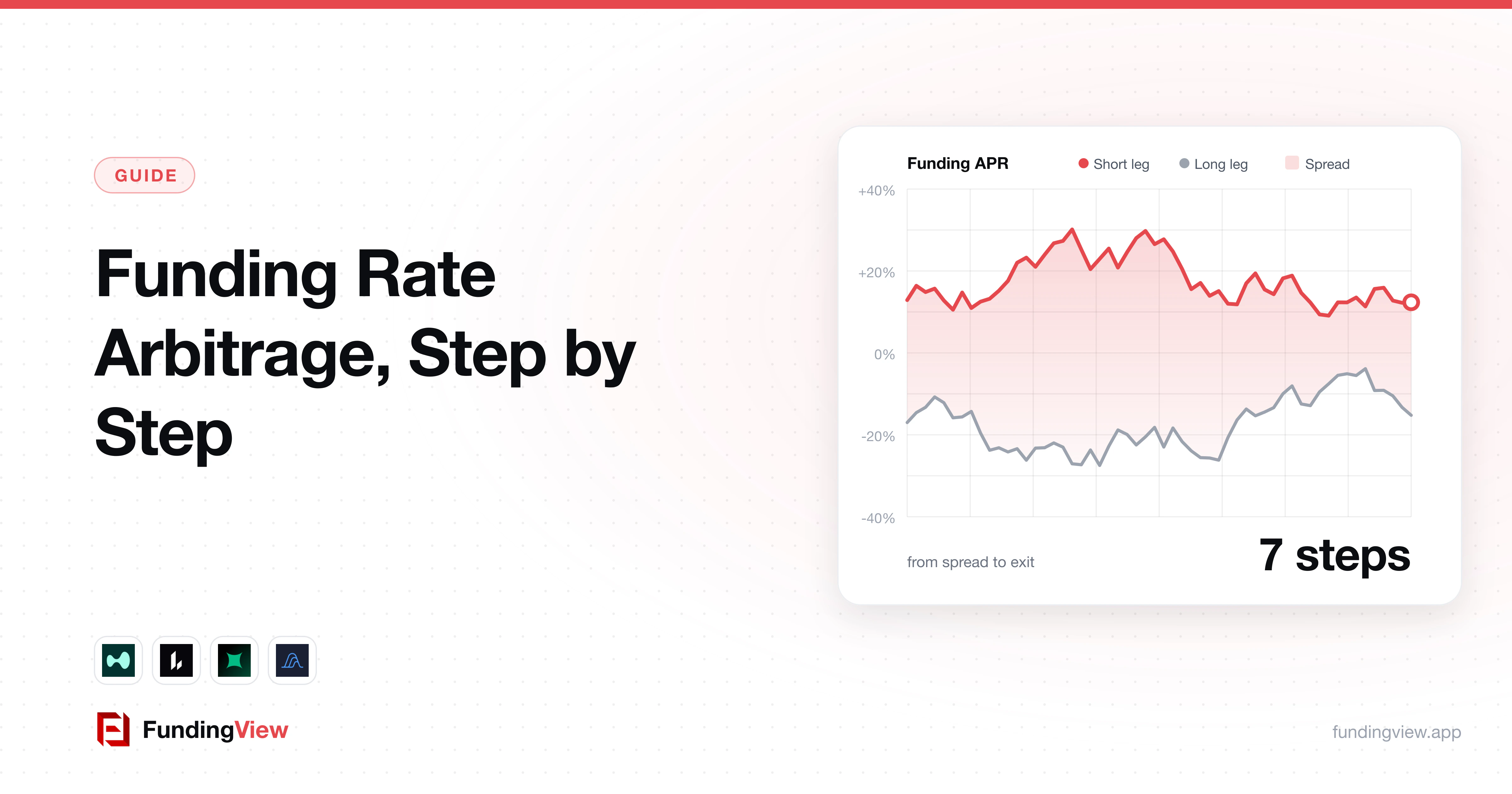
Funding Rate Arbitrage: A Step-by-Step Guide for 2026
The complete funding rate arbitrage playbook: finding a spread, checking that it lasts, sizing both legs, opening and monitoring the position, and knowing when to exit.
Funding rate arbitrage means holding a long and a short on the same asset, on two venues, to collect the difference in their funding rates while price moves cancel out. This guide walks through the whole process, from finding a spread to closing the trade.
New to funding? Read what funding rates are first.
Step 1: Find a spread
Open the dashboard. Every row is a strategy:
- Long leg: the venue with the lowest funding (you pay the least, or get paid).
- Short leg: the venue with the highest funding (you get paid the most).
- APR: the annualised difference, already normalised for each market's funding interval.
Filter to venues where you have accounts. Use Must use to force your main venue on one leg.
Step 2: Check that it lasts
Today's spread means little on its own. Open the strategy page or the Best Strategies list:
- 30-day average spread: is it consistently positive?
- Score: FundingView rates how stable and persistent the spread has been.
- History chart: did it spike once, or does it hold?
A steady 15% beats a 150% spike that lasts six hours.
Step 3: Check that it is the same asset
Make sure both legs trade the same thing. FundingView splits same-ticker, different-asset markets (CAT the stock vs CAT the memecoin), but always glance at the prices on both venues before trading.
Step 4: Estimate costs
- Fees and slippage at your size: see Execution Cost.
- Rule of thumb: required APR ≈ round-trip cost × 365 / holding days.
- Run a backtest with your execution cost in bps to see the net result.
Step 5: Size and open
- Same notional on both legs, not the same margin.
- Leverage of 2x to 3x gives room for wicks. Liquidation of one leg is the main risk.
- Open both legs within seconds of each other, using limit orders where you can.
- On 8h or 4h venues, time the entry right after a settlement.
Step 6: Monitor
- Check the spread at least once a day.
- Watch your margin on both venues. The winning leg's profit does not protect the losing leg's margin.
- Rebalance when price moves a lot: one leg gains margin, the other loses it.
Step 7: Exit
Close when:
- the spread turns negative for more than a day or two;
- a better spread appears elsewhere and covers the switching cost;
- either venue shows signs of trouble (paused withdrawals, depeg).
Close both legs together, again with limit orders when possible.
Common pitfalls
See the 10 funding arbitrage mistakes. The top three are comparing rates without normalising intervals, ignoring execution cost on short holds, and over-leveraging one leg.
FAQ
How much can funding arbitrage make? Stable spreads on majors are often 5% to 15% APR. Mid-caps can pay much more, for shorter periods.
Do I need a bot? No. Many traders run a handful of positions manually and check them daily.
What about CEXs? CEX ↔ DEX spreads are often wider. See CEX vs DEX funding arbitrage.