
CEX vs DEX Funding Arbitrage: Trading Binance, Bybit and OKX Against Perp DEXs
Funding on Binance, Bybit or OKX often differs from Hyperliquid, Lighter or Extended for the same coin. How a CEX ↔ DEX funding spread works, what it pays and what can go wrong.
Most funding arbitrage tools compare perp DEXs with each other. But the biggest pools of leveraged traders are still on centralised exchanges: Binance, Bybit, OKX, Bitget, Gate, MEXC, KuCoin, BingX and Kraken. Their traders do not position like DEX traders, and their funding rates often disagree.
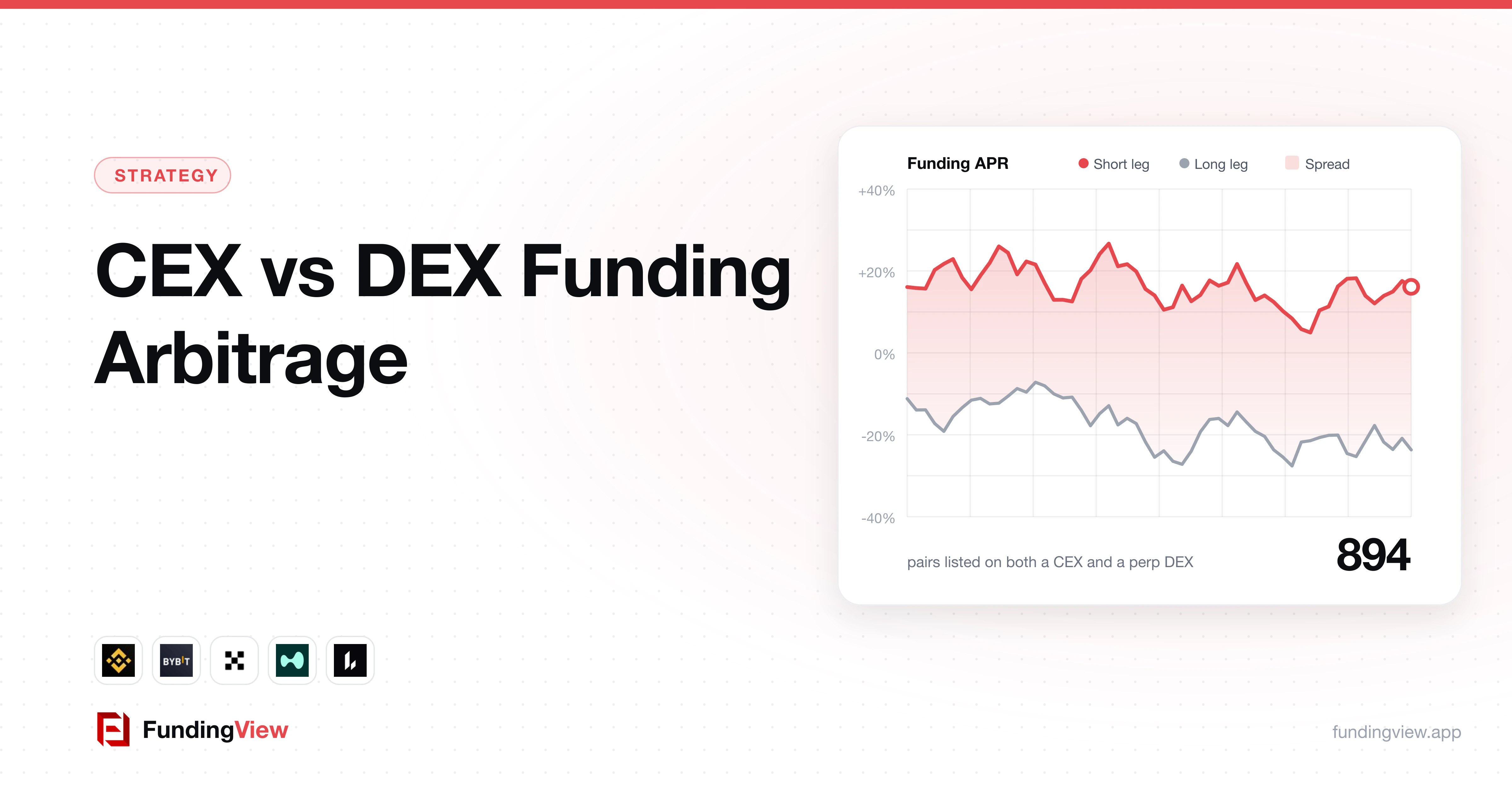
When we added 9 CEXs to FundingView, we found 894 pairs listed on at least one CEX and one perp DEX at the same time. Every one of them is a potential CEX ↔ DEX funding spread.
See the live CEX ↔ DEX spreads →
The strategy in one sentence
Go long on the venue where funding is lowest, go short on the venue where funding is highest, with the same notional on both legs. Price moves cancel out, and you collect the difference between the two funding rates.
Example with live-style numbers:
| Leg | Venue | Funding APR |
|---|---|---|
| Long | Bybit | −12% (longs get paid) |
| Short | Hyperliquid | +18% (shorts get paid) |
| Spread | 30% APR |
On a $20,000 position ($10,000 per leg), a 30% APR spread is about $8 a day before fees, as long as the spread holds.
Why CEX and DEX funding diverge
- Different traders. CEX order flow is retail-heavy and very sensitive to news. DEX flow includes more points farmers and market makers hedging inventory.
- Different intervals. Most CEX markets settle every 8 hours, many every 4 hours. Most perp DEXs settle hourly. A CEX rate looks small until you normalise it.
- Different caps and formulas. Each venue clamps funding in its own way. During squeezes one side hits its cap while the other keeps climbing.
- Listings. A coin often lists on CEXs first. Early funding on a new listing can be extreme.
Normalise before you compare
The classic mistake is comparing "0.01%" on Binance with "0.01%" on Hyperliquid. One is per 8 hours, the other per hour: an 8x difference.
FundingView reads the native interval of every single market. On Bybit, MEXC and Bitget, almost half of the USDT perps settle every 4 hours, not 8. Each rate is converted to an hourly rate, then to APR. The dashboard shows each leg's interval so you know exactly when you will be paid.
Watch out for ticker collisions
The same ticker does not always mean the same asset:
- CAT is Caterpillar stock on most venues, but a memecoin on MEXC.
- CVX is Convex Finance on crypto venues, but Chevron on Hyperliquid's stock markets.
- DASH is the coin on MEXC and Bitget, while their DoorDash perp is listed as DASHSTOCK.
Matched blindly, these produce "spreads" of thousands of percent that do not exist. FundingView groups every venue's quotes by price for each ticker. Venues quoting a different asset are split into their own market, such as CATSTOCK or CVXSTOCK, instead of being matched by mistake.
Costs that eat the spread
- Trading fees. CEX taker fees are often 0.04% to 0.06% per side. A round trip on both legs can cost 0.2% of notional, which is 2.4% of APR if you hold for a month.
- Slippage. Check Execution Cost for the size you trade.
- Withdrawal and transfer time. Rebalancing between a CEX and a DEX means moving collateral across chains, which is slower than moving it between two DEX accounts.
- Spread decay. Extreme spreads rarely last. Use the backtester to see how long similar spreads held in the past.
Risk checklist
- Liquidation on one leg. Your hedge does not help if one leg gets liquidated during a wick. Keep leverage moderate and margin on both venues.
- Counterparty risk. You now hold funds on a centralised exchange and on a DEX. Size accordingly.
- Funding flips. A spread can invert. Re-check the rates every few hours, or set alerts.
How to find CEX ↔ DEX spreads on FundingView
- Open the Live funding view and look at "Best CEX ↔ DEX spreads".
- Or, on the dashboard, open the Exchanges menu, enable the CEX group, and use "Must use" to force one venue on a leg.
- Click a row to open the strategy page with both legs' history.
CEX funding data is part of FundingView Premium. See what Premium includes →
FAQ
Is CEX ↔ DEX arbitrage riskier than DEX ↔ DEX? It adds custodial risk and slower rebalancing, but the spreads are often larger.
Which CEXs does FundingView track? Binance, Bybit, OKX, Bitget, Gate, MEXC, KuCoin, BingX, Kraken Futures and Backpack.
Do I need KYC? For most CEXs, yes. Perp DEXs usually only need a wallet.
Related: How to choose a DEX for funding arbitrage · Funding intervals explained