
Execution Cost and Slippage on Perp DEXs: How Much Does a $100K Order Really Cost?
Fees are only half the cost of a trade. How slippage works, why it grows with order size, how to compare venues at 1K, 10K, 100K, 500K and 1M USD, and how it changes a funding strategy's real return.
A funding strategy can show 25% APR on paper and still lose money. The usual culprit is not the funding rate but execution cost: the fees and slippage you pay to open and close both legs.
This guide explains slippage, how it scales with size, and how to factor it in before you trade.
Compare execution cost by venue →
Fees vs slippage
- Fees are what the exchange charges: maker and taker, in basis points (1 bp = 0.01%). Many perp DEXs charge very low or zero taker fees to retail, while CEXs typically charge 4 to 6 bps per side.
- Slippage is the gap between the mid price and your average fill price. A market order walks through the order book, eating the best price levels one after another.
Execution cost (bps) = taker fee + slippage
A "zero-fee" venue with a thin book can cost more than a venue with fees and deep liquidity.
Why size changes everything
Slippage is not linear. A $1,000 order fills at the top of the book. A $1,000,000 order can go through dozens of levels. Typical behaviour:
| Order size | What happens |
|---|---|
| $1K – $10K | Almost no slippage on majors, fees dominate |
| $100K | Slippage appears on mid-caps and on smaller venues |
| $500K – $1M | Large gaps between venues, some books cannot fill it at all |
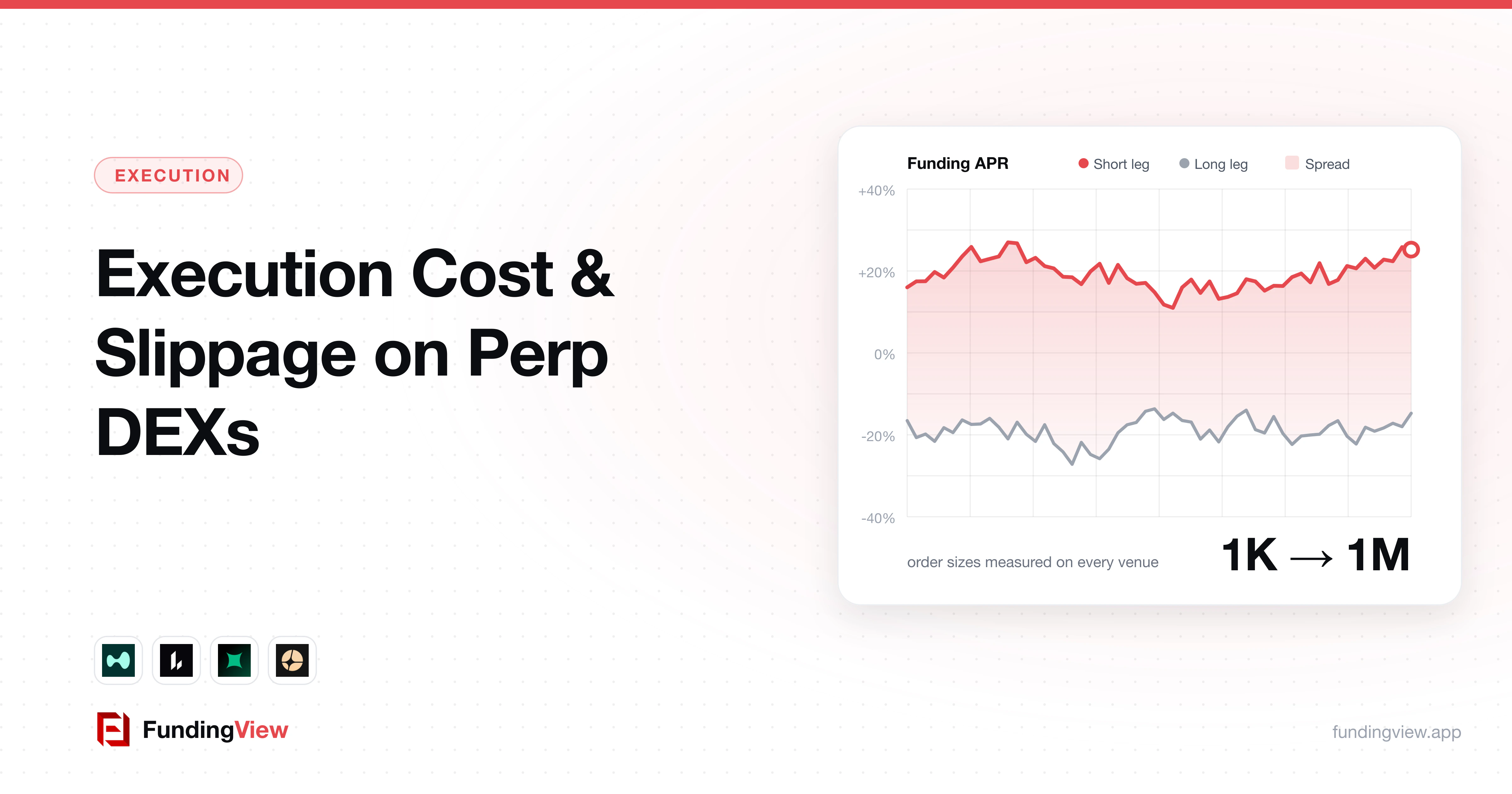
FundingView measures the cost of a market order at 1K, 10K, 100K, 500K and 1M USD on each venue, from live order books, and averages it over time.
Turning execution cost into an APR hurdle
A delta-neutral strategy pays execution four times: open long, open short, close long, close short. If each leg costs 5 bps per trade:
4 × 5 bps = 20 bps = 0.20% of notional
If you hold the position 30 days, that 0.20% is worth 2.4% APR that the funding spread must cover before you earn anything. Hold 7 days and the hurdle becomes 10.4% APR.
Rule of thumb:
Required spread APR ≈ round-trip cost × 365 / holding days
The FundingView backtester lets you enter an execution cost in bps and subtracts it from the simulated P&L.
How to reduce execution cost
- Use limit orders for the leg you can wait on. Maker fees are often zero or negative.
- Split large orders over time instead of one market order.
- Pick the deepest venue for the big leg. Check Execution Cost at your actual size, not at $1K.
- Avoid opening right after news, when books thin out.
- Hold longer. The longer you hold, the smaller the cost per year.
What the data usually shows
- Majors (BTC, ETH, SOL) are cheap almost everywhere up to $100K.
- Long-tail altcoins and RWAs (stocks, commodities) can cost 10 to 50 bps at $100K on smaller venues.
- Order book depth changes during the day. RWA books are thinnest outside market hours.
FAQ
Is execution cost the same for longs and shorts? Not always. Bid and ask depth can differ, so buying and selling the same size can cost different amounts.
Why do some venues show no data at 1M? Their book cannot fill a $1M order without moving the price excessively, or the venue caps the order size.
How often is execution cost measured? Continuously, with hourly averages kept as history so you can see trends over weeks.
Related: Funding arbitrage mistakes · How to backtest funding strategies